


Current location: HOME > BLOGS > Frequently Asked Questions >
UV and Weather Resistant Solar Cable for Desert and Coastal Solar Farms
time:2026-10-15 11:34:11 author:haoshizai Click:176
A solar farm in a desert faces 50 °C ambient, extreme daily thermal cycling and abrasive sand. One on a coast faces salt spray, constant humidity and chloride corrosion. Both face a UV load far higher than any other cable application. The UV resistant solar cable specification is where these projects succeed or quietly lose yield for decades.
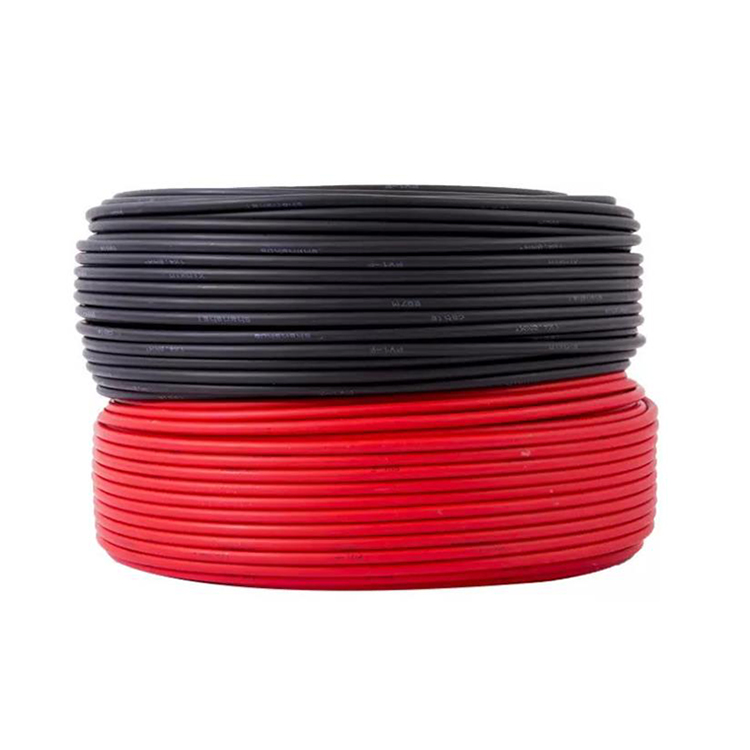
This article breaks down each environmental stressor and the corresponding cable design response, so that developers and EPC contractors can specify weather resistant photovoltaic cable with confidence rather than habit.
Desert Conditions: Heat, Thermal Cycling and Abrasion
Desert sites combine peak ambient temperatures near 50 °C with intense irradiance and large day-to-night swings. Cable clipped to structure under a module can see conductor-region temperatures well above ambient, which is exactly the condition that separates cross-linked insulation from ordinary thermoplastic.
Sand is the second enemy: wind-driven abrasion thins the sheath over years, and dust ingress into poorly sealed terminations creates tracking paths. Specifying a cross-linked, abrasion resistant sheath and sealed, correctly crimped connectors addresses both.
Cross-linked sheath retains strength at extreme temperature
Abrasion resistant compound for wind-blown sand
Thermal cycling fatigue resistance at clipped spans
Sealed terminations to prevent dust tracking
Red and black cores that remain legible after UV exposure
Coastal Conditions: Salt, Humidity and Corrosion
Chloride-laden air attacks two things: bare copper and metal connector components. Tinned copper conductors resist it directly, and halogen-free sheath compounds avoid releasing corrosive gases that would accelerate attack on nearby metalwork.
Cable routing matters too. Runs that trap salt-laden moisture against structure corrode faster than ventilated runs, so clips that hold the cable off the mounting surface, together with proper drainage at low points, materially extend life in coastal installations.
Tinned copper conductor resists chloride corrosion
Halogen-free sheath avoids corrosive combustion products
Hydrolysis resistant compound for humid environments
Ventilated routing and drainage at low points
Corrosion-resistant hardware and sealed connectors
High UV Load and Ozone Exposure
Photovoltaic cable carries DC at high voltage in full sun, which generates ozone at the sheath surface - a particularly aggressive oxidiser. The sheath compound therefore needs combined UV and ozone stabilisation, verified by accelerated weathering and ozone resistance testing rather than assumed from colour stability alone.
The visible symptom of an under-specified sheath is chalking, then micro-cracking, then water ingress. By the time cracking is obvious during an inspection walk, a large part of the array may already be affected, which is why the specification stage is the only cheap place to make this decision.
Combined UV and ozone stabilised sheath compound
Accelerated weathering test evidence
Resistance to surface chalking and micro-cracking
Stable colour and legible marking after exposure
Halogen-free formulation for environmental safety
Temperature Extremes: From -40 °C to +90 °C
Photovoltaic cable is rated for continuous conductor temperatures around 90 °C and must remain flexible at -40 °C so that winter installation and maintenance does not crack the jacket. These are opposing requirements, and meeting both is a function of the base polymer and the cross-linking process.
The practical test is simple: a correctly formulated cable can be bent around a mandrel after cold conditioning without cracking, and it does not deform under clamp load after heat ageing. Both behaviours are part of the standard DC solar cable test regime.
90 °C continuous conductor temperature rating
Short-circuit withstand around 250 °C
Cold bend performance down to -40 °C
No deformation under clamp load after heat ageing
Stable flexibility through seasonal cycling
Water, Buried Duct and Flood-Prone Sites
Many utility projects route DC cable in buried duct. That introduces standing water, hydrostatic pressure and the possibility of long-term immersion - conditions that cause hydrolysis in unsuitable sheath compounds and wick water along the conductor if the cable is not properly constructed.
Where duct routes cannot be drained, the specification should explicitly address water immersion behaviour, and installation practice should include sealed duct entries and draw-in procedures that avoid sheath damage during pulling.
Hydrolysis resistant sheath for wet and buried routes
Sealed duct entries to limit water migration
Correct pulling tension and lubrication during installation
Low-point drainage wherever the route allows
Inspection of duct condition before cable pull
Specifying Solar Cable for Harsh Sites: a Practical Checklist
Harsh-environment specification is mostly about making the implicit explicit: naming the standard, naming the conductor treatment, naming the sheath properties, and requiring the test evidence that proves each one. A specification that only states a cross-section leaves every durability decision to chance.
Hebei Haoshizai Cable Co., Ltd. supports this process by supplying tinned copper Class 5 photovoltaic cable with cross-linked halogen-free insulation and sheath across the full size range, produced under documented process control and available with the routine test records that project documentation requires.
Name the standard: EN 50618 / IEC 62930 or UL 4703
Specify tinned copper Class 5 conductor
Specify cross-linked halogen-free insulation and sheath
Require UV, ozone and heat ageing test evidence
Define installation practice for routing, clipping and sealing
Frequently Asked Questions
Is standard photovoltaic cable suitable for desert projects?
Yes, provided it is a cross-linked H1Z2Z2-K style construction with UV and abrasion resistant sheath. Desert projects additionally benefit from careful clipping, sealed terminations and attention to sand abrasion at contact points.
Why is tinned copper important for coastal solar farms?
Chloride in coastal air corrodes bare copper and raises contact resistance at terminations. Tinned strands resist that corrosion and keep terminations stable over the project life.
What temperature range should solar cable handle?
Continuous conductor operation around 90 °C, short-circuit withstand around 250 °C, and flexibility down to -40 °C for cold-climate installation and maintenance.
Can photovoltaic cable be installed in buried duct?
Yes where local code permits. Use a hydrolysis resistant construction, seal duct entries, avoid standing water where possible and control pulling tension during installation.
How is UV resistance verified?
Through accelerated weathering and ozone resistance testing defined in the DC solar cable standards, supplemented by heat ageing and tensile testing after exposure.
Do harsh sites require larger conductor sizes?
Often yes, because high ambient temperature and bundling reduce current carrying capacity. Derating should be applied explicitly rather than relying on free-air catalogue values.
About the manufacturer: Hebei Haoshizai Cable Co., Ltd. produces TUV certified photovoltaic DC cable and solar cable — H1Z2Z2-K 1×4 mm² to 1×35 mm², H1Z2Z2-K 2×4 mm² and 2×6 mm², GF-EER23 2×4 mm² and 2×6 mm², plus 2.5 / 4 / 6 / 16 mm² single-core and 2×4 / 2×6 mm² constructions — together with new energy EV wiring in 16 / 25 / 35 / 50 / 70 mm². Multiple automated production lines, layer-by-layer quality inspection, standardised workshops and consolidated export delivery support both large-scale ground-mounted plants and distributed rooftop projects.






CONTACT
Email:525860526@qq.com
Whatsapp: +86 19933450664
TEL:+86 17803069333
WEB:https://www.haoshizai-solar.com
ADD:Dongyang Village, Daweihe Hui and Manchu Township, Wenan County, Langfang City, Hebei Province